5 tips for protecting waterways when fertilising your soil


With September well underway, and fertiliser deadlines approaching, it is a busy period ahead for farmers.
Despite this, it is still important to ensure that water quality remains a priority.
The Teagasc Better Farming for Water Campaign has five top tips to ensure that waterways remain protected while still making use of valuable nutrients.
Actions taken now will have a significant impact on both nutrient use efficiency and water quality.
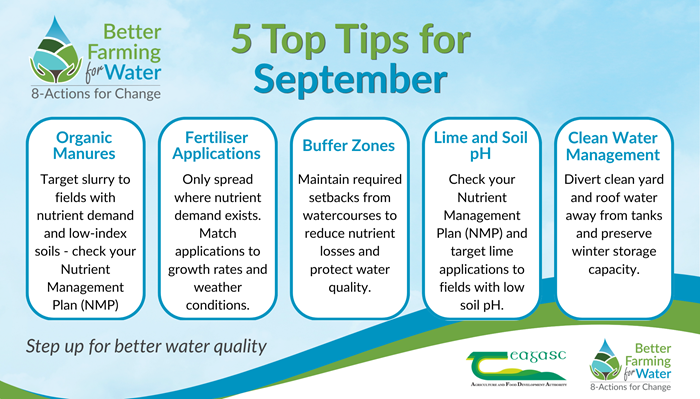
Here are Teagasc’s five tips for protecting water quality while continuing to take advantage of nutrient use efficiency.
1. Slurry and organic fertilisers
Teagasc advises farmers, when spreading slurry, to target soils that is classified as a low index soil on their Nutrient Management Plan (NMP).
Other fields that should be targeted include recently grazed paddocks and silage, as these will provide better returns both economically and environmentally.
As usual it is advised to not spread slurry on waterlogged ground or where the risk of run-off is higher.
Avoiding nutrient loss to water should be the main objective, while also maximising nutrient uptake.
Using low emission slurry spreading (LESS) equipment when fertilising soil will also maximise nutrient recovery.
2. Application
While the deadline for organic fertilisers is October 1, the application of chemical fertiliser must end by September 15.
Only crops or grass with genuine nutrient demand should be fertilised.
This summer's drought may have caused soil temperatures to remain relatively high, which can cause potential nitrogen mineralisation.
This will vary, depending on the farm and soil types, as well as region.
This natural release of nitrogen can contribute significantly to crop and grass growth during September and should be considered before applying additional fertiliser.
According to Teagasc, where grass growth rates are above 35kg DM/ha/day, farmers may consider applying up to 25kg N/ha (20 units N/acre) before September 15.
Excessive application will be inefficient and will increase the risk of nutrient loss later in the year.
3. Buffer zones around water ways
This remains one of the most effective measures for protection watercourses, according to Teagasc.
Setback distances outlined in Good Agricultural Practice for Protection of Waters (GAP) regulations include:
- 3m from surface waters for chemical fertiliser applications.
- 5m from surface waters for slurry, soiled water, and other organic fertilisers.
- 10m from surface waters where land slopes greater than 10% towards a watercourse.
- 20m from lake shorelines and turloughs likely to flood.
It should also be noted that the setback distance for organic fertilisers and soiled water increases from 5m to 10m during the two weeks before the September 15 deadline, according to Teagasc.
4. Good time to spread lime
Lime is the most ideal way to correct your soil fertility before winter creeps back in, Teagasc said.
Autumn is the ideal time to make use of one of the most cost-effective inputs available.
Correcting soil acidity improves the availability of nutrients already found in soils, such as: phosphorus; potassium; and nitrogen.
According to Teagasc, farmers should check their NMP to identify where lime is needed.
Improving soil pH can lead to: stronger root development; improved nutrient uptake; and healthier soil biology.
5. Keeping clean water clean
Avoiding contamination in water in the first place is the most effective step.
Now is the time to check gutters, downpipes, and drainage systems as rainfall gets heavier.
The National Agricultural Inspection Programme (NAIP), still identifies issues with relating to clean and dirty water separation, roof water management, and soiled water generation on farms, Teagasc said.
Heavy downpours can also cause sediment and organic matter to move towards waterways.
Ensuring runoff pathways are checked can ensure water is separated, which according to Teagasc "reduces storage requirements and improves nutrient management flexibility".
According to Teagasc, carefully managing slurry; fertiliser; buffer zones; soil pH; and farmyard drainage can maximise the value of nutrients on farms value ensuring that water zones remain protected.