Transport taxes 'disproportionately' impact rural Ireland - hauliers


Haulage companies are being “pushed to the brink” and rural communities are being disproportionately impacted by transport taxes, according to the Irish Road Haulage Association (IRHA).
The group cites rising fuel taxes, along with transport charges and levies, as damaging to businesses across rural Ireland.
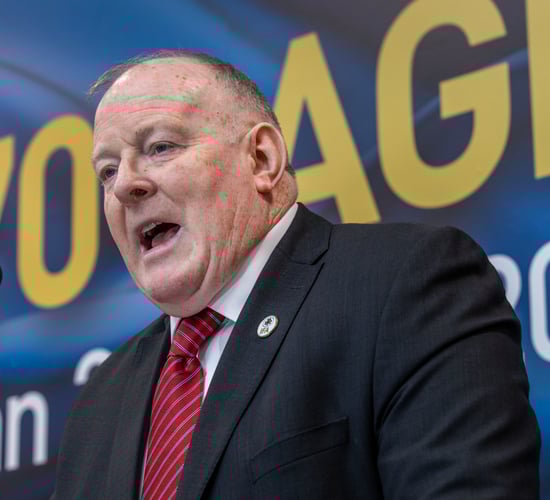
Ger Hyland, president of the IRHA, has spoken of the series of new government-imposed fuel taxes, new toll charges, and fuel levies that started on January 1, 2026.
Irish diesel prices are now among the highest in the EU, according to Hyland.
He said: “Every extra penny at the pump and every levy on our livelihoods is another nail in the coffin of the haulage industry, but also on small business in rural Ireland.
“Haulage companies are being pushed to the brink, with some already forced out of business, as fuel taxes, increased tolls, new port charges and carbon taxes rise relentlessly.
“That is also driving the cost of potatoes, milk, bread and other supermarket staples that are delivered in the back of a truck.”
Hyland accused the Irish government of punishing rural Ireland.
“The government takes the easy option every time and hike taxes on transport – which disproportionately impacts on rural Ireland, where there is no viable public transport alternative,” he said.
“The Irish economy is being made uncompetitive by our own government.
“At a time when international competition is fierce, the state is actively undermining Irish businesses in rural Ireland by loading additional costs onto the transport sector, which underpins every part of the economy.”
The IRHA president said that the government does not seem to "grasp the damage they are doing to the Irish economy. and to rural Ireland in particular" or that "as an island nation", Ireland needs to be competitive.
Fuel price increases
The Department of Transport has said its Renewable Transport Fuel Policy (RTFA) for 2025-2027 is intended to increase the use of renewable fuels in the transport sector, to help reduce the emissions impact of petrol and diesel and contribute to the overall decarbonisation of transport.
According to a statement from Fuels for Ireland, over the five-year period up to January 1, a series of policy decisions have pushed fuel prices higher.
These include carbon tax rises, rising obligations under the Renewable Transport Fuel Obligation (RTFO), and higher targets under the Energy Efficiency Obligation Scheme have driven increases in the Better Energy Levy.
Fuels for Ireland said: "These measures will have added around €19 to the cost of filling a typical 60L tank over that five-year period, including the further increase of about 5c/L due at the very beginning of 2026."
Separately, Circle K has announced the following price increases for 2026:
- Under the RTFO, the blending rate will rise from 25% to 32%, increasing the cost of unleaded petrol by 2.1c/L and diesel by 3.2c/L (excluding VAT);
- The Better Energy Levy will increase from €0.012/L to €0.017/L (excluding VAT) across all fuel grades.
Ports and tolls
The IRHA president also highlighted that there are also new charges at Dublin Port - a 5% increase in container prices combined with a new €15 infrastructure charge.
Toll prices are rising too, with the Dublin Port Tunnel toll set to increase by €1 during weekday mornings, while "HGVs on the M50, M4, M3 and other routes face further increases".
According to Hyland, "some hauliers are already paying up to €250,000 a year in tolls alone".
In response to these charges, the IRHA said: “One industry – transport – cannot be made responsible for carrying the burden of all climate change measures.”