Sponsored
Tipperary dairy farmer slashes electricity costs with solar and batteries

Sponsored by

For a 110-cow herd, a 59-panel solar array and a battery bank have taken most of the electricity cost out of the milking routine.
On a 110-cow dairy farm near Holycross, Co. Tipperary, electricity was the cost the farmer could do least about.
His two-monthly bill sat at about €2,500. His most recent one was €500, and most of the electricity he still buys from the grid is at the night rate.
He said: “The electricity bill was the one cost I couldn’t do anything about.
"The milk cooler, the water heating and the milking machine run every day, whatever the price.
"Now the panels and the battery cover most of it, and the bill is a fraction of what it was.”
Why electricity costs matter more this year
The timing is tough for dairy farmers. Teagasc forecasts that average dairy farm income will fall 49% in 2026, to about €78,000, as lower milk prices combine with rising input costs.
Electricity is part of that squeeze.
The CSO reports that wholesale electricity prices in August 2026 were 76.9% higher than a year earlier, and suppliers are passing increases on.
Bord Gáis Energy raised its electricity unit rate by 9.1% from October 9, following an SSE Airtricity increase announced days earlier.
Milk cooling, water heating and the milking machine account for around three-quarters of a dairy farm’s electricity, according to Teagasc, and none of it can be switched off.
What’s on the farm
ProSolar is an SEAI-registered installer and part of a 30-year-old family business in energy technology.
It designed the system around the farm’s daily demand.
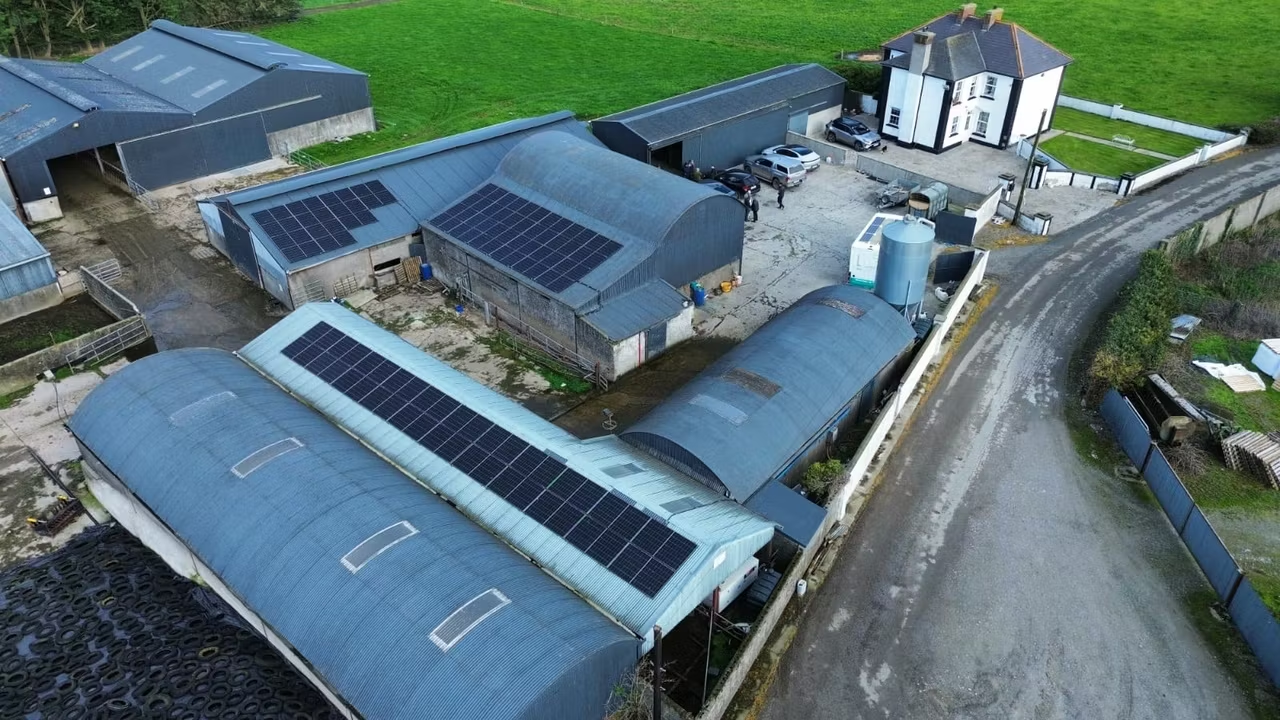
It is a Sigenergy SigenStor system with 15kW of single-phase inverter capacity and a 45 kWh battery bank, connected to 59 solar panels (29.8 kWp) on a corrugated metal shed roof.
How it works through the day
Milking happens twice a day, so demand comes in two peaks, around 8:00a.m and 6:00p.m, with very little load in between.
The battery bridges the gap. It charges overnight at the night rate and covers the morning milking and milk cooling when the day rate starts.
The panels refill it through the middle of the day, and surplus is exported and paid for by the supplier.
One ordinary autumn day: September 30
On September 20, the farm used 110kWh and bought just 2.9kWh at the day rate.
On unit rates, the day’s electricity cost about €9.92 after export income, against roughly €34.42 without solar.
That is a saving of about €24.50 in a single day, in autumn rather than midsummer.
Over the year, the solar and battery system saves the farm more than one cent for every litre of milk it produces.
Ahead of projection
Since switch-on on June 16, the system has generated around 12,000 units of electricity, surpassing expectations by 16%.
The battery has supplied 5,660kWh, mostly into the early-morning and evening milking.
ProSolar projects the farm would use only about 35% of its solar output without batteries. With them, it has used 76% on site.
Systems should be designed for self-consumption, and the battery is what delivers that security long into the future.
Design, installation and aftersales
Results like these depend on more than hardware. A well-designed, expertly installed and properly set up system needs feedback and aftersales support behind it.
The system records where the farm’s power comes from every five minutes, and ProSolar has helped the farmer find the loads that use the most electricity.
Ronan O’Connor, agri solar consultant at ProSolar, says sizing is what makes the difference.
He explained: “Dairy farmers can’t control milk price or the weather, but with solar PV and a properly sized battery they can take control of their electricity.”
Payback and funding
ProSolar expects paybacks of three years or less after grants, on a system designed to last 20 years.
The SEAI Non-Domestic Microgen Grant has doubled for new applications made between October 6, 2026 and July 6, 2027, and now rivals the funding available under the TAMS 3 Solar grant with much less red tape.
SEAI applications are direct, with no ranking process. Qualifying equipment can also be written off in full in the first year under Accelerated Capital Allowances.
System costs and savings vary with farm size, usage, layout and system design, and will be lower in winter when solar output falls, so ProSolar assesses each farm individually.
Considering solar for your farm?
ProSolar will assess your farm’s electricity usage and give you a straight answer on what a system could save and which grant route suits you.
The sooner you get it, the sooner you save.
Sponsored by