National Dairy Council School Farm Visits
Latest research commissioned by the National Dairy Council (NDC) shows that more than half (56%) of parents with children under 12 in Ireland say their child has never seen a cow being milked.
But across the country, efforts are now underway to reconnect children and young people with the origins of their food and to teach them that milk does not come from a shop – it comes from nature, farms and the people who care for them.
Ireland's dairy farmers believe it is vitally important that children understand where milk really comes from and among them is Kerry farmer Leo O’Connor.
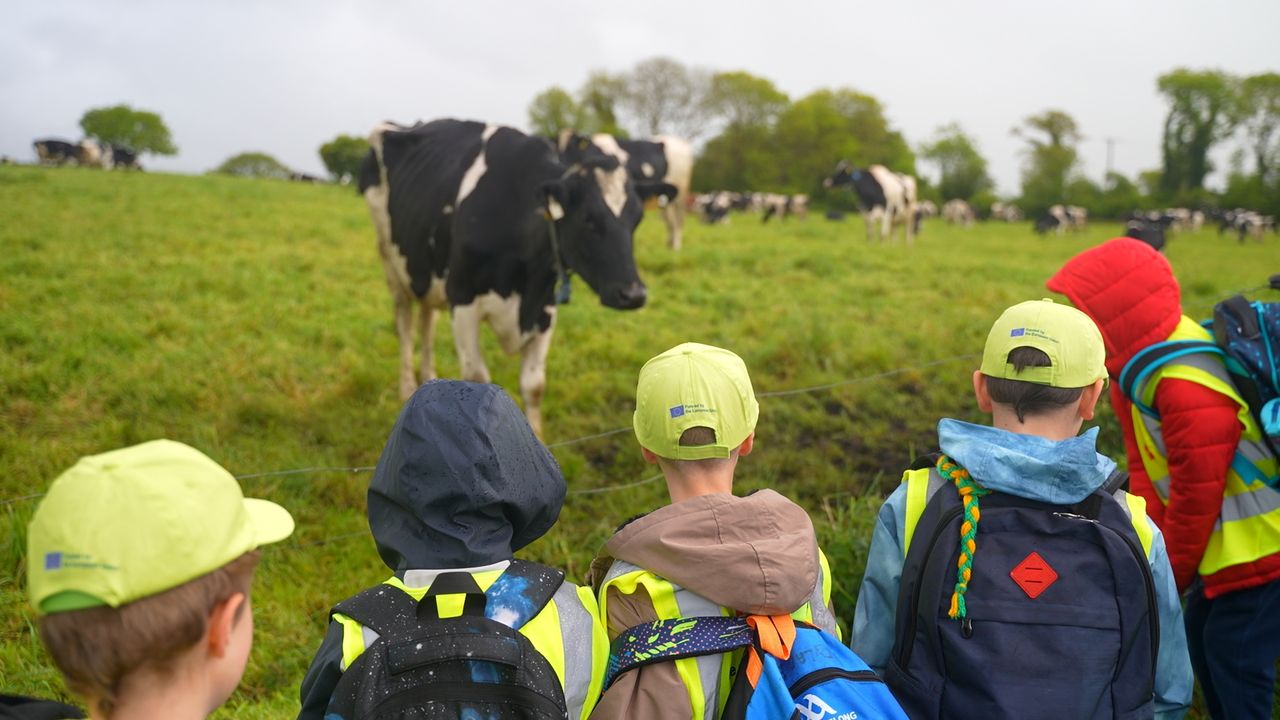
He was delighted to welcome hundreds of primary school children to his family farm to see for themselves exactly where milk starts.
The visit to Leo's farm is just one example of the National Dairy Council’s (NDC) campaign to help children understand and see both the source and value of milk.
The O'Connor farm is a family-run enterprise, with three generations involved in the business.
Leo said: “I'm farming here just outside Tralee, with my parents John Joe and Maureen, my wife Fiona, my son Thomas and then I have a daughter Orla and a son Daithi who come out on the farm as well.
“It's a grass-based dairy farm, in which we produce our milk in winter and spring.
"We calve half our cows before, let's say, the middle of December and then we start calving again at the end of January right up until towards the latter weeks of April.”
The NDC farm visits give schoolchildren the chance to step outside their classrooms and see first-hand where their milk and the dairy products that they enjoy come from.
By giving children and the opportunity to meet farmers and explore working dairy farms, pupils can get a better understanding of the journey from farm to fridge.
That, in turn, helps them to build a connection with food, farming and the people behind it.
Farm visits are ‘very important’
According to Leo "farm visits are very important for the younger generation".
"An awful lot of their parents would have had some connection to agriculture but that's now grandparents," he said.
“And even today when kids are here they say ‘my grandfather had a farm’ or whatever.
“I think it's very important for the primary school kids to come out, see a farm, see what does a cow look like, understand that it’s produced in a clean environment, off-grass, into a carton, and then they think they’re buying it from a shop, essentially.
“And it doesn't come from the shop, it comes from nature, it comes from a farm, and just to show them really how it's produced," the Kerry dairy farmer said.
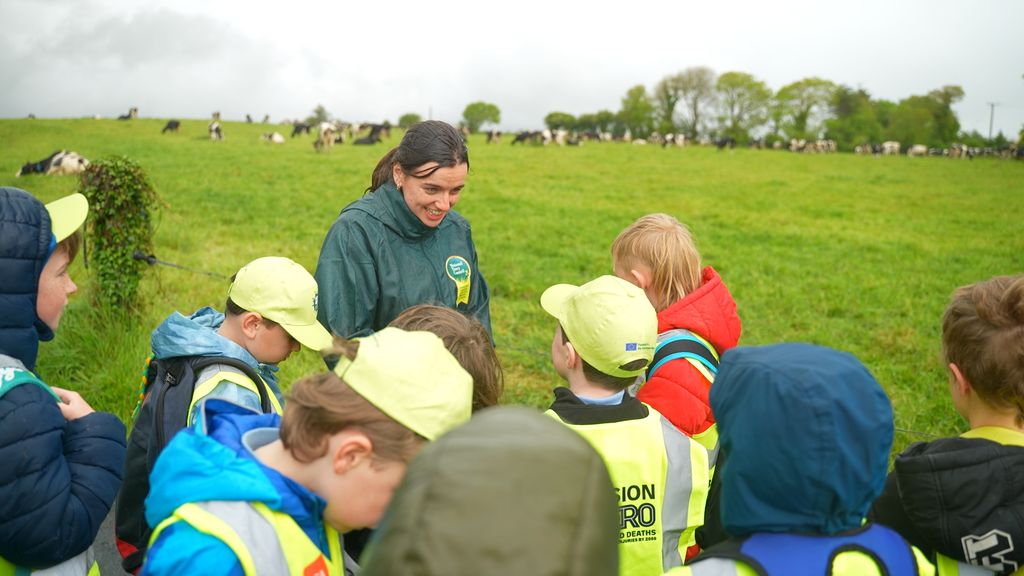
During the visit to Leo's farm school children got the opportunity to see five activity stations up close including:
- The paddock - where students went into the fields to see cows and observe and handle grass;
- The milking parlour - where the schoolchildren witnessed demonstrations of cows being milked;
- The nutrition benefits - where students learned about dairy products and their nutritional benefits;
- The importance of Trademark - where students were presented with milk cartons and learned about the Trademark Guarantee:
- The calving area - where the schoolchildren were introduced to the calves.
According to Leo he is “not surprised” that many children today in Ireland have never seen a cow being milked.
He said: “There's a gap now between their grandparents who might have milked cows.
"The numbers are dropping the whole time - the number of people that are involved in dairying is dropping.”
The Co. Kerry farmer said that, in particular, families and children living in urban areas "might not quite understand what's involved or how important it is to the local and rural communities".
He passionately believes that farmers are the "guardians of nature".
"We produce food and we're here for the betterment of the countryside," Leo said.
Unique country
During their visit to Leo's farm the children also got to learn about the impact Ireland's weather has on milk production.
Leo happily pointed out to them while the weather is sometimes wet, it is ideal for producing certain foods, as "everything is grass-based".
He added: “Ireland is a unique country.
“I know we got plenty of rain, it's raining here again today, but it does produce an awful lot of grass.
“The cows are designed to eat the grass and they produce a very high quality product.
“At the end of the day, the food we have in this country is exceptional."
The children, who were all from third and fourth class in schools across Co. Kerry, were very vocal about what they had learned on the day of the visit.
“We learned about how much grass they eat and how much water they need and how much water and milk calves need,” one of the girls said.
“The cows get milked and the milk goes through a pump, then it goes and gets sold to shops,” her friend added.
Some of her class mates also said they had found out that milk is “good for your muscles”, “has protein”, and that you can get “calcium” * from milk.
Each child received a dairy-filled goody bag to take home, giving them a tasty reminder of their day on the O'Connor farm.
EU School Milk Scheme
The National Dairy Council School Farm Visits initiative is part of the wider EU School Milk Scheme (SMS) which has operated in Ireland since 1982.
The SMS is managed by the National Dairy Council and funded by the European Union with the support of the Department of Agriculture, Food and the Marine (DAFM).
The EU SMS provides participating schools with a daily supply of milk at discounted rates, together with educational supports that promote the nutritional value of daily dairy consumption.
Through this combination of milk provision and learning activities, the scheme is designed to help reconnect children with agriculture and encourage healthy eating habits for life.
Interested schools can find out more at www.moocrew.ie/schoolmilk.
Keep updated on how NDC are bridging the rural/urban divide by signing up to the free newsletter here.
*Milk is a rich source of calcium and protein. Protein contributes to growth in muscle mass, and calcium is needed for maintenance of normal bones.
The NDC School Farm Visit series is a collaboration with Agriland about the importance of school visits to farms in familiarising children with all aspects of food production.