New technologies could double Brazilian agri-output on current farm land

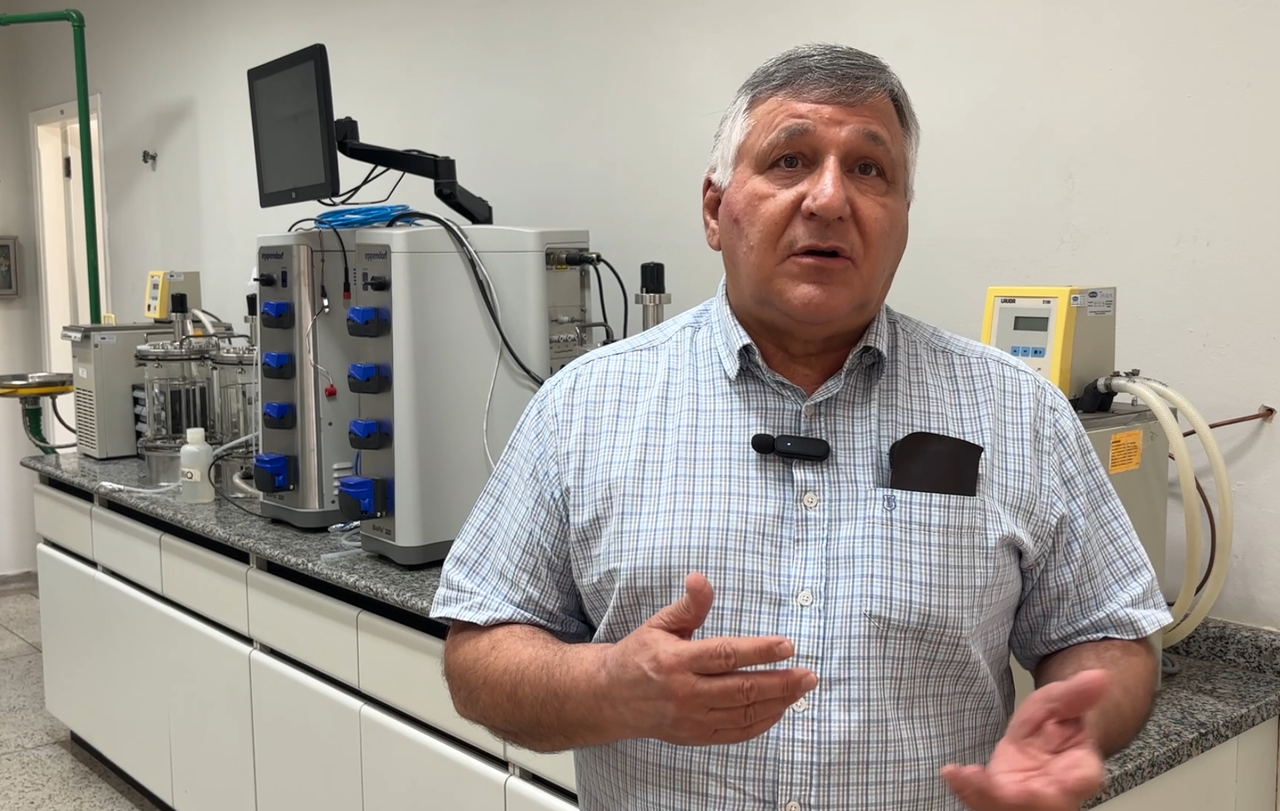
Brazil is "uniquely placed" to potentially double agricultural production on its existing farmland in the next 50 years, according to one genetics professor at the University of Sao Paulo in Brazil.
Dr. Carlos Alberto Labate from the university's Department of Genetics believes that that new technologies, particularly in biological disease and pest control, will greatly increase the level of agricultural output from the existing farmland in the country.
Agriland visited the University of São Paulo while on a trip in the Brazil looking at agricultural production in the region.
The university is involved in a Brazilian agricultural biotechnology company called 'Genica'.
The company essentially identifies strains of bacteria that can prevent crops from both disease and pest attacks, acting as a potential alternative to chemical controls.
Genica is a relatively new business, marking its 10th anniversary in 2025.
Dr. Labate explained an agricultural management concept in Brazil known as "tropical agriculture", and said that this is something the country has only recently gained a more comprehensive understanding of.
Tropical climate
Because of the tropical climate in Brazil, it is not uncommon to grow two crops/year on the same area of land (and more in some cases) and also run cattle on this land also.
So in some regions of Brazil, the climate makes it possible for three farming activities on the same land in one year.
For example, a crop of soya can be grown and harvested, then a crop of corn or maize planted known as "second-crop corn".
The grain of this corn is harvested and cattle can graze the stalks after harvest, resulting in three farming activities on that area of ground within the year.
Because the tropical climate allows for growth all year round in several regions, there is no winter to "kill off" pests or diseases, so crop disease control is a big area of focus.
Dr. Labate explained: "What we are doing with Genica is to exploit the native microbiota.
"Tropical agriculture is something that we are learning more about now.
"Over the last 40 years, we started to understand that we have a different system of production."
The Brazilian professor, who also studied at the University of Sheffield in the UK some 40 years ago, said that when he was a student: "We learned how to how to prepare the soil with huge machines and we understood later on that this was wrong.
"Minimum cultivation is what we have to do to protect this soil and this is something people should understand.
"That's why Brazil is producing so much because we have developed now in the last 40 years and we understood that we are producing in a tropical environment.
"We are using more and more of this knowledge and the biologicals today."
Intensification not deforestation
There is a mantra in the Brazilian agricultural sector now of 'intensification not deforestation' and there is growing focus on increasing crop output from the existing farmland in the country.
Prof. Labate explained: "In Brazil, if we consider all the area of agriculture, we are now about 80 million-100 million hectares of cultivation."
He added that there are at least 160 million hectares with some slow-producing pasture.
"So we can get, say, 50-70 million hectares of this land that is being, let's say under-utilised and then we can improve [this land] with these new regeneration technologies that we are applying in agriculture.
"So Brazil has no limit [to increasing production] without going into the Amazon. That's very important. See, without destroying the forest, the capacity that Brazil has to produce more and more."
"Of course, you have climate change. You have all sort of challenges that's important for all of us but Brazil has the capacity and Brazil is uniquely placed I think," Prof. Labate said.
Why does he believe the country is 'uniquely placed?
The professor said that the tropical climate in Brazil is what makes it uniquely placed.
He said: "If you if you compare Australia, Australia is dry in the last 100 years.
"Australia is a fantastic place, but they they recognise now that the amount of water that they have is decreasing, and this is a major problem.
"Brazil has also the same problems in some of the areas."
He said that the increasing knowledge and awareness of tropical agricultural production in Brazil "has a good possibility to provide all these technologies to Africa".
Concluding, the professor said that Brazil can contribute to food production for the next 50 years.
He believes that developments in new technologies, particularly in plant disease management, have the potential to "double the capacity".