Inside the 2026 Quality Milk Awards: Meet the Finalists Series
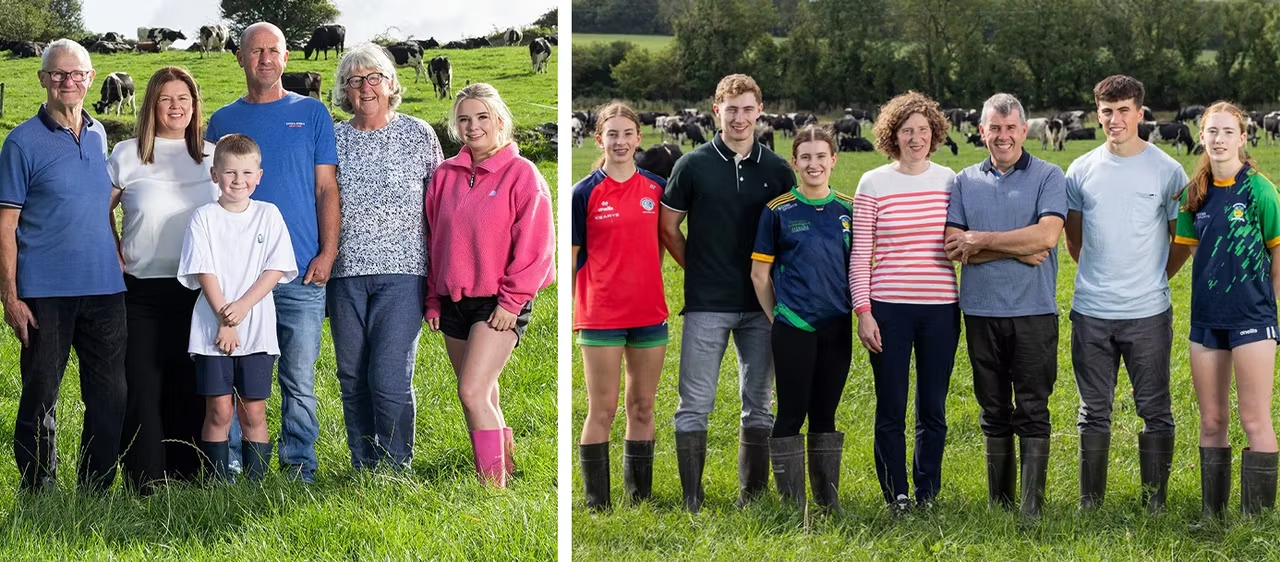
In this Inside the 2026 Quality Milk Awards: Meet the Finalists series, we meet the farms nominated by each of the dairy co-operatives and delve into their individual stories.
In episode four, we meet the O'Donoghues from Leap, Co. Cork, who were nominated by Drinagh Co-op.
We also meet the Troy family from Newtownshandrum, Co. Cork, who were nominated by Kinisla.
The Troys were chosen as the Overall Winner on the night, after they also snapped up the award for Best Milking Hygiene/Facilities.
O'Donoghue Farm - Drinagh Co-op
The dairy story here in Maulatrahane, Leap, Co. Cork predates Donal O'Donoghue by three generations.
His grandfather Timothy milked six or seven cows in the 1940s.
His parents, Donie and Hannah-Mary then farmed the holding and raised their family from it.
Donal remembers that the 16 cows were enough for his parents to live well and bring up their children, an achievement he respects more, not less, after building the herd himself.
After attending Darrara Agricultural College in 1999, Donal returned with a clear intention to farm.
He began developing the holding and Donie retired in 2004, but there was no single dramatic transformation.
Marginal ground was reclaimed, more land was leased, roadways and yards were improved, and cow numbers rose as the farm became ready for them.
He said: “There is always something that can be improved."
The latest work is additional slurry storage and housing at the home yard: another practical step, rather than expansion for its own sake.
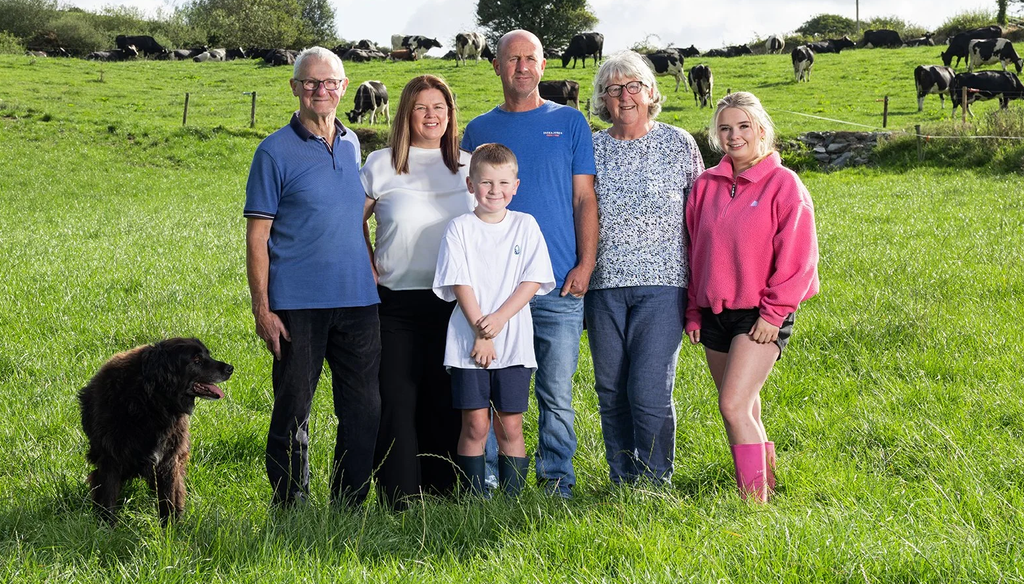
The family remains visible in the way the place works.
Karina, Donal's wife combines farm life with her job in AIB in Skibbereen.
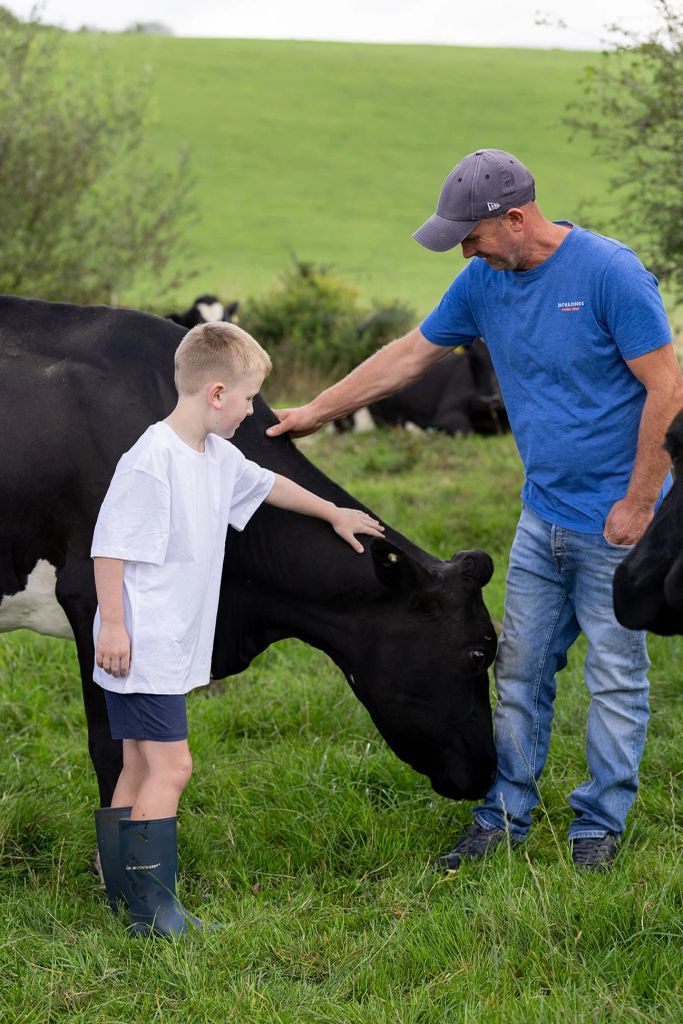
Daughters, Alanya, now a teacher, and Neela, who is preparing for her Leaving Certificate, are part of the wider team; eight-year-old Darragh is already useful at herding.
Donal’s nephew Cian steps in for machinery work and milking.
The arrangement is informal but real: when the work gathers, the family gathers with it.
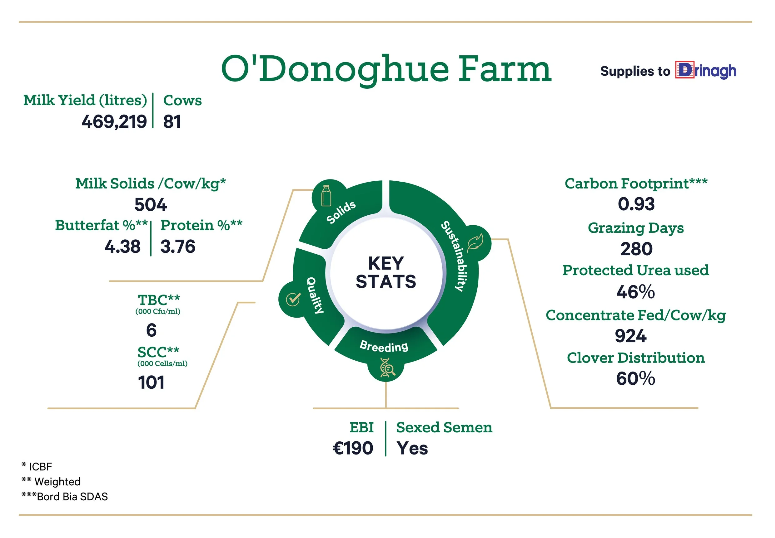
If there is a signature to the milk that leaves Maulatrahane, it is not a single headline figure but a quiet reliability.
Total bacterial count sits in the single figures for most of the year, the mark of a parlour run the same disciplined way at every milking.
Donal milk records four times a year and treats each report as information rather than paperwork: any cow whose cell count edges up is California Mastitis Test (CMT)-tested, the offending quarter identified, and if it does not respond she is dried off and given her chance again next year.
Some of the most valuable infrastructure at Maulatrahane does not appear on a farm map.
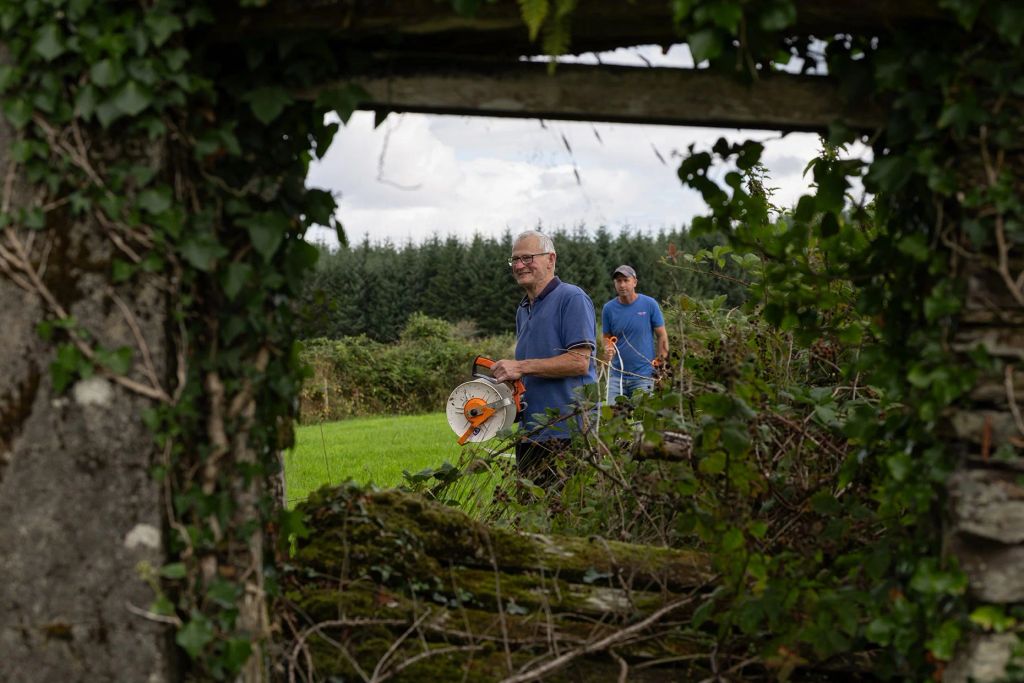
It is the friendship with his neighbour Brendan O’Driscoll of Shreelane.
Brendan and Pauline represented Drinagh nationally in the 2019 NDC & Kerrygold Quality Milk Awards, when their transformation of difficult rocky ground into highly productive dairy land earned the Development Award.
Donal admires what Brendan created and describes him as both a sounding board and someone he shares important jobs with.
Drying off is a good example. Brendan helps Donal one day and Donal returns the favour on Brendan’s farm. Brendan’s son Sam also provides relief milking.
There is no invoice that can fully value that kind of neighbourliness, yet it is the oldest idea in the co-operative movement: farmers sharing labour, knowledge and confidence so that each farm is stronger.
Grass management
At 2.4 cows to the hectare, the farm is deliberately not overstocked; there is room for grass to grow and for cows to graze it.
Clover is worked into every reseed to trim the nitrogen bill, the wet spring tested it, as it tested everyone’s, and roughly 60% of the platform now carries it.
Silage is all baled, no pit, fed out three times a week, and grass is walked and budgeted on PastureBase with covers held around 1,500.
The result is a farm that treads lightly: a carbon footprint of 0.93kg CO2 equivalent per kg of fat and protein-corrected milk, comfortably inside the low band that makes Irish grass-based milk among the least carbon-intensive in the world.
Breeding too is consistent. There is no sexed semen and no chasing of fashion, British Friesian artificial insemination (AI) to begin, run for a spell twice a day, then two Hereford stock bulls to finish, with bulls chosen for protein above all.
It is a policy built for a herd that lasts, and it shows in the tank: butterfat of 4.38%, protein of 3.76% and 504 kilos of milk solids per cow.
Away from the yard, Kilmacabea GAA is the family’s great outlet.
Donal played for years, and the club remains part of family life.
The same instinct that has him home early each evening also protects time for matches, family occasions and the ordinary evenings that can disappear when a farm is allowed to consume every available hour.
Troy Farm - Kinisla
Overall Winners
Winners - Milk Hygiene/Facilities
A daffodil-lined avenue provides the first welcome to the Troy family farm at Corrough, Newtownshandrum, a sweep of colour before the scale of the enterprise comes into view.
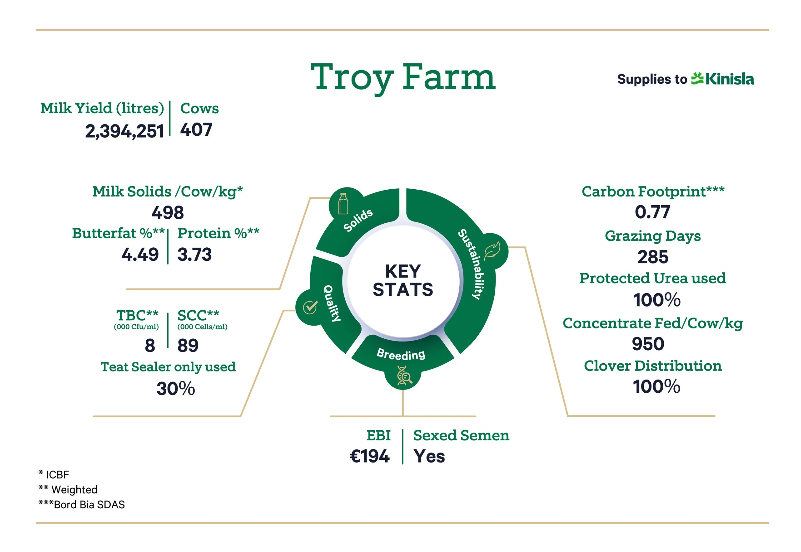
The figures that follow are formidable: 425 cows, a herd in the top 1% nationally for Economic Breeding Index (EBI), 11 home-bred bulls accepted into artificial insemination (AI) stations, 100% clover across the grazing platform and a carbon footprint reduced to 0.77kg CO2 equivalent per kg of fat and protein-corrected milk. Yet numbers tell only half of the story.
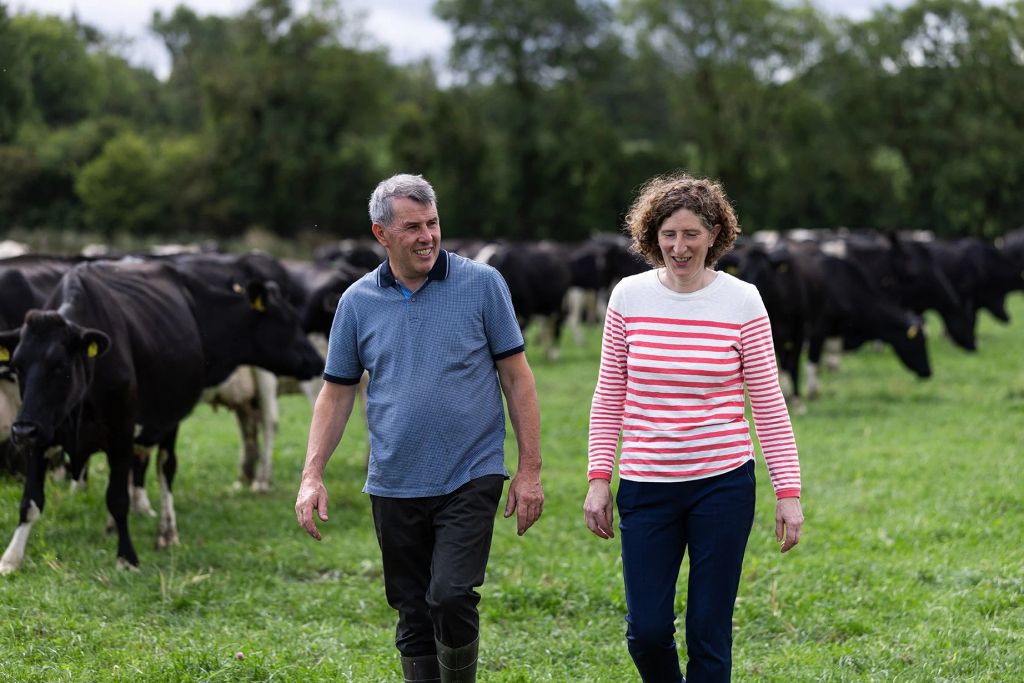
The real achievement is the way Robert and Mary have combined science, stockmanship and scale while raising five children who are already part of the farm's work, sport and future.
Robert is the fifth generation of Troys to farm in Newtownshandrum and the fifth of 12 children himself.
He studied mechanical engineering, but a three-month placement in New Zealand in 1993 opened his eyes to what grass-based dairying could achieve in Ireland.
He returned home, grew the herd from 140 to 200 cows over the following 12 years and married Mary in 2002.
A University College Dublin (UCD) food science graduate who worked in quality assurance with Dairygold, Mary brought a complementary understanding of food production and the disciplines that protect quality.
Herd genetics
Robert is a disciple of Teagasc geneticist Donagh Berry, and his breeding policy rests on 25 years of HerdPlus and Irish Cattle Breeding Federation (ICBF) records.
The herd is fully genotyped.
Robert carries out his own AI from a panel of about 35 bulls, working from a dedicated platform beside the 44-unit rotary, so breeding does not interrupt milking.
Twenty years ago, the Troys experimented with Jersey genetics but found that carefully selected Holstein-Friesians could deliver the fertility and solids they required.
Maintenance, fertility and constituents now drive selection, with the long-term target a functional cow approaching 5% fat and 4% protein.
Milk quality shows that attention to detail has survived expansion.
In 2025, an average of 407 cows delivered 202,617 kg of milk solids.
The litre-weighted figures were approximately 89,000 cells/ml for somatic cell counts (SCC) and below 8,000 cfu/ml for total bacteria count (TBC), with butterfat at 4.49% and protein at 3.73%.
The production system is deliberately simple: calving runs from February 1 to mid-April; breeding begins in early May and runs to the end of July, and the herd is dry in December and January.
Cows are at grass within days of calving, and the farm records a 285-day grazing season.
The aim, in Robert's phrase, is to build to the May 1 peak and "hold the curve as long as you can".
In 2025, the platform grew about 15t of dry matter per hectare.
The farm's carbon footprint has fallen from 0.92 in 2017 to 0.77kg CO2 equivalent per kg of fat and protein-corrected milk in 2026 through a fertile, low-maintenance cow, compact calving, grass utilisation and lower dependence on purchased feed.
Clover is established across the entire grazing platform, protected urea accounts for all chemical nitrogen and slurry is targeted by soil need.
Through Kinisla’s Evolve programme and two EIP projects, the family has planted trees each winter, fenced watercourses and created buffer zones, two ponds and a reed-bed system.
Corrough also serves as a working classroom. Agricultural science students from Charleville CBS are welcomed onto the farm and shown how breeding, grass, welfare, water quality and labour management fit together.
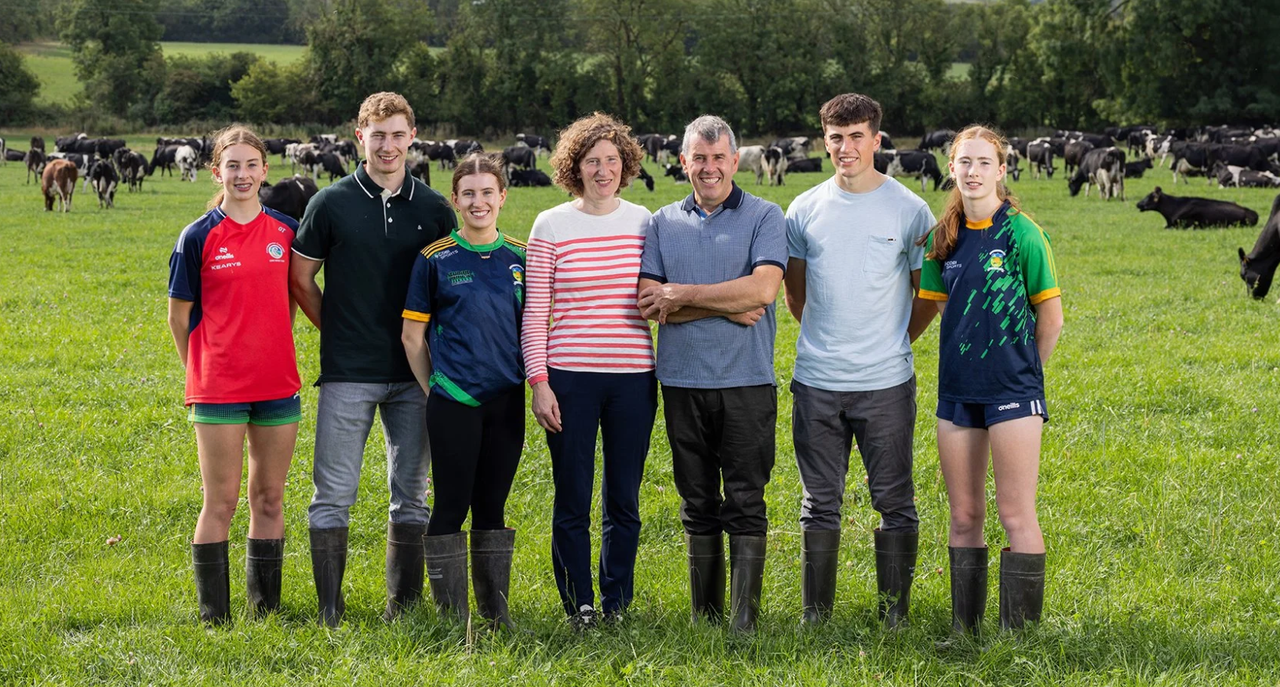
Perhaps the most telling measure of the farm is that all five children have found a place within it without being made to fit the same mould.
Rory is studying agriculture, while Robert Junior has followed his father's engineering route.
On the farm, they share responsibility for grassland management, milking, calf feeding, animal husbandry, vaccinations, machinery, building maintenance, and electronic repairs.
On the field, both line out in senior hurling for Newtownshandrum, and Rory has also been part of the Cork under-20 hurling panel.
Fiona, Orla, and Eimear are every bit as practical.
They milk cows, feed calves, herd stock and take responsibility for the cleaning and order that keep a large farm functioning properly.
Orla has carried the family colours beyond the parish: selected for the Cork minor camogie team in 2026, she contributed scores during Cork's All-Ireland semi-final against Kilkenny.
Mary is secretary and a selector with the local camogie club, making the connection between yard and playing field a family commitment rather than a weekend diversion.
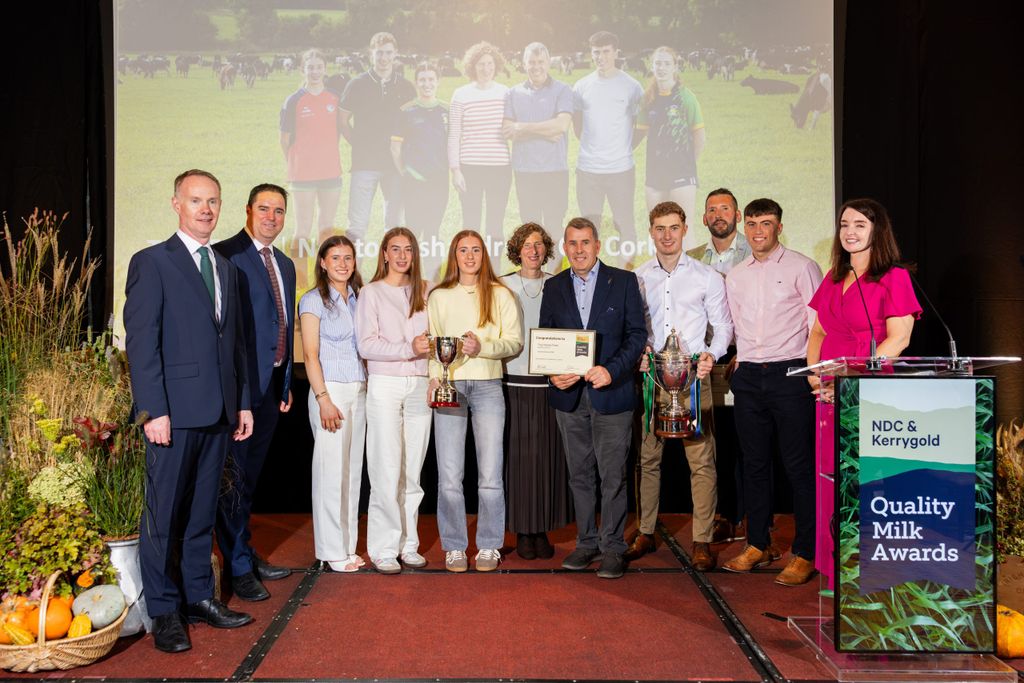
The lasting memory of the Troy farm is of a family in which knowledge is shared; responsibility is real, and achievement is measured in more than litres or indexes.
Robert and Mary have built a technically outstanding dairy business; Rory, Robert Junior, Fiona, Orla and Eimear make it feel like a place with a future.
At Corrough, the data tells the truth, but the family completes the story.
More information on all the finalists is available on the Quality Milk Award YouTube page.
The Inside the 2026 Quality Milk Awards: Meet the Finalists series is a collaboration between Agriland, the National Dairy Council and Ornua.