Sponsored
How advanced fatty acid technology is helping farmers rear more resilient calves


Sponsored by

Calf rearing remains the cornerstone of herd performance for Irish dairy producers, especially in seasonal block‑calving systems where consistency and resilience matter more than ever.
Over the past 15 years, Trouw Nutrition’s LifeStart science programme has delivered a sequence of breakthroughs that have reshaped our understanding of what calves need during the crucial pre‑weaning period.
First LIFESTART evolution
Uncovering the benefits of restoring calves to natural milk volumes
Dr. Aaron Brown, technical sales manager for Trouw Nutrition, explained: "LifeStart research clearly demonstrated that to unlock the exceptional growth and developmental potential of pre-weaned calves, they must be offered higher volumes of milk for longer.”

Rather than restricting milk to “force” concentrate intake, research showed that feeding at least 8L of quality milk replacer:
- Increases daily energy intakes at the time calves can use it most efficiently;
- Supports the maturation of key internal organs;
- Leads to long-term benefits in health, fertility, milk yield, and longevity.
Second LIFESTART evolution
Reshaping milk replacer fat content using whole milk as the biological reference
After demonstrating the benefits of allowing calves to consume milk closer to their natural appetite, LifeStart research then focused on the macro-nutrient profile of calf milk replacers.
Traditional replacers typically contained lower fat and higher osmolality - a combination that limited energy density to the developing calf and increased the risk of digestive stress which can lead to bloat and diarrhoea.
Findings showed that calves thrive when replacers more closely resemble the fat levels of whole milk by providing higher energy for growth and development.
This understanding drove the development of Energized Calf Milk in 2017, with increased fat and lower osmolality.
This step was pivotal: not only did it increase metabolisable energy per kilogram of dry matter, it also improved nutrient tolerance and supported healthier gastrointestinal development in early life.
Latest LIFESTART evolution
Harnessing the secret power of shorter-chain fatty acids
LifeStart science has now moved to the next frontier: understanding the composition of milk fat itself and how it influences calf development.
Dr. Brown explained: “Bovine milk fat is one of the most complex in nature, containing over 400 different fatty acids, including a wide range of shorter chain fatty acids largely absent from the vegetable oil fat blends commonly used in calf milk replacers.”
These shorter chain fatty acids play essential roles in:
- Gastrointestinal tract development;
- Rumen priming;
- Nutrient absorption;
- Early‑life resilience and immune function.
Product innovation leads to new generation of calf milk replacer
Until recently, the industry’s challenge was finding a way to incorporate enough of these functional fatty acids without compromising palatability or creating strong odours that reduce intake.
This is where the latest scientific breakthrough has resulted in a new patented fatty acid product.
LactoFat Pro successfully overcomes the issues of inclusion, meaning milk replacers containing it will provide a more complete fatty acid profile. It is only available in Milkivit ONE Energized Calf Milk.
Trials confirm that one of the biggest benefits of feeding Milkivit ONE is in the development of the gastrointestinal tract, where the villi - the absorptive area in the gut - are longer and more developed, meaning there was a bigger surface area for absorbing nutrients.
The improved gut integrity plays a vital role in protecting calves against diarrhoea.
Feeding Milkivit ONE compared to a traditional Energized Calf Milk was shown to reduce the incidence of diarrhoea.
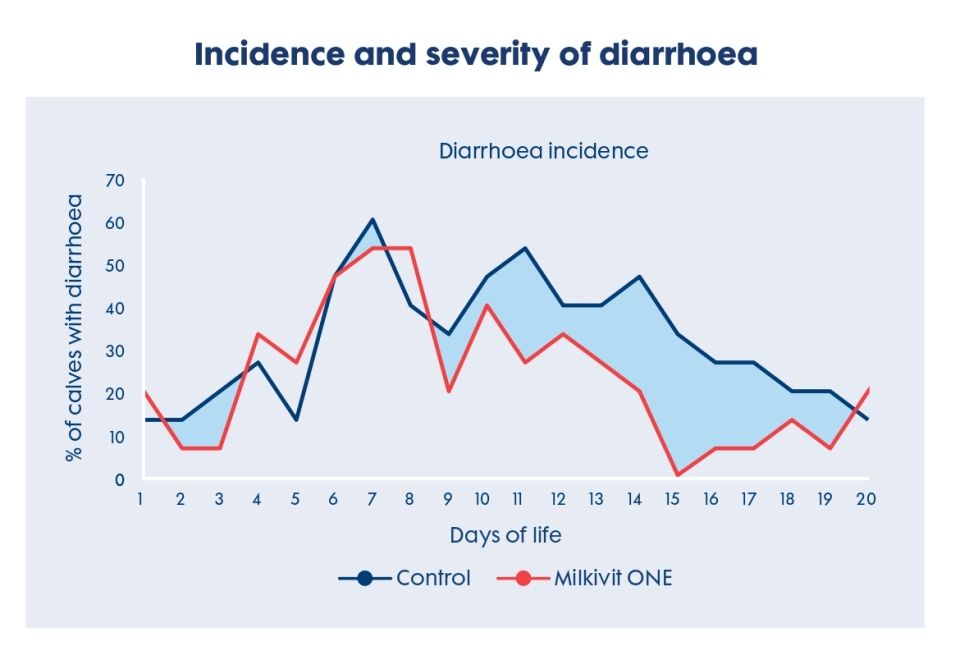
In addition, these calves required fewer treatment days and had a reduced risk of mortality.
Many farmers who have switched to Milkivit ONE have commented on seeing a marked reduction in the cost and time spent on treatment and management of sick calves.
At Perry Farm, Devon, UK, Charlotte Wallbridge said: “Calving has gone very well this year. We’ve had zero boat, zero mortality.
"[As for] antibiotic usage, all I’ve done is jabbed two calves - no pneumonia issues or scours.
"When I walk into the barn and into the calf pen, I’m very, very pleased with how they look; they’re very healthy, vibrant, always skipping around the pen playing with their toys."
What this means for Irish dairy farmers
For farmers aiming to improve the resilience of their calves for an easier rearing period, this latest development marks a meaningful step forward.
Optimising early life nutrition supports the rearing of uniform, robust heifers that calve down stronger before 24 months and perform reliably across multiple lactations.
Feeding for resilience now means:
- Feeding sufficient volumes to capture both short and long-term benefits;
- Elevating energy intake through high fat, low osmolality replacers;
- Optimising the fatty acid profile to support the biological systems that underpin calf robustness.
Milkivit ONE with LactoFat Pro represents this next step - but more importantly, it signals where calf nutrition is heading: toward replacers that do not simply supply nutrients, but actively support gastrointestinal development, rumen maturation, and the calf’s ability to withstand early life challenges.
Sponsored by