Sponsored
A practical approach to sustainable Irish farming

Sponsored by

As the feed and food supply chain faces continual pressure to reduce its environmental footprint, the term sustainability has been well documented across all sectors of the agricultural industry worldwide. But what does this look like on a practical level?
As animal nutritionists, we rely heavily on reports and means of measurements to benchmark how well farms are performing. This same level of reporting and measurement can be used to measure the level of sustainability of Irish farms.
When working with farmers who wish to improve their farm’s carbon footprint, there are several areas Alltech Ireland focuses on to increase and improve efficiency.
Assessing the farm
The first step for producers in reducing farm emissions is to identify what level the farm is starting at, the carbon footprint of the farm and the sources of emissions.
It begins at farm level, by first measuring the current carbon footprint of the farm. Alltech E-CO2 does this by first looking at the farm’s inputs across the whole year, such as feed and fertiliser, and measuring them against the outputs, be this the kg of milk solids produced or kg of beef produced.
Alltech E-CO2 then evaluates the farm’s efficiency based on its emissions. Key areas where a carbon footprint can be improved are then highlighted.
After this initial benchmarking process, we then work with the farmer throughout the year to implement a plan to mitigate the farm’s environmental impact.
Rumen health
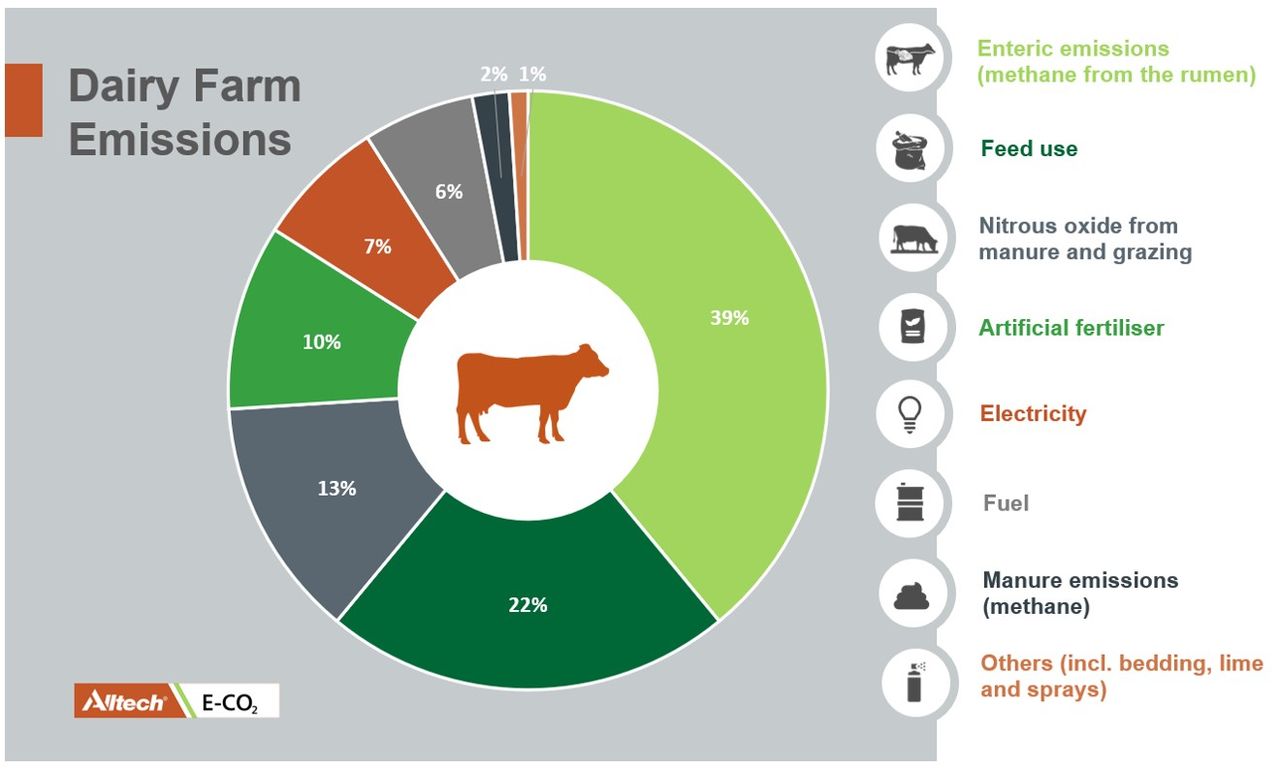
Looking at Graph 1 from Alltech E-CO2, the rumen can account for up to 39% of a typical dairy farm’s carbon footprint. As a result, this is a key area to focus on.
The reason the rumen accounts for so much of the farm’s emissions is that it produces volatile fatty acids (VFAs). VFAs form through rumen fermentation and are essential for providing the animal’s energy supply. They are then used to generate kg of milk solids.
Any undigested feed is wasted and produces gases such as methane. The more efficient the rumen is at creating VFAs, the less methane gas is produced.
The type and amount of VFAs produced all depends on the feeds going into the rumen. Keeping the rumen as healthy as possible begins with maintaining a stable rumen pH of 6.0. Anything less and the rumen can start to show signs of acidosis.
Formulating a diet for optimum performance starts with knowing and testing the quality of the feeds being used. Depending on the stage of lactation, the cows will have specific requirements for energy, protein and fibre to produce kg of milk solids.
By maintaining a healthy functioning rumen year-round, cows avoid dips in milk protein six weeks’ post-calving and can beat the drop in milk fat when the fibre content drops in grass during the second rotation. These increases in rumen efficiency all lead to optimised milk solid production.
Optigen is Alltech’s non-protein nitrogen source for ruminants. It concentrates the nitrogen fraction of the diet, creating dry matter space for more fibre and energy.
Optigen is a technology that delivers a sustained release of ammonia to the rumen over time to meet the needs of the microbial population more effectively than conventional protein sources.
Unlike other wasteful and potentially risky nitrogen sources, Optigen is a safe and traceable source that increases the efficiency of rumen nitrogen capture, resulting in less nitrogen waste.
The Carbon Trust has certified that the replacement of high-carbon ingredients (such as soya) with Optigen significantly reduces the risk of a high carbon footprint.
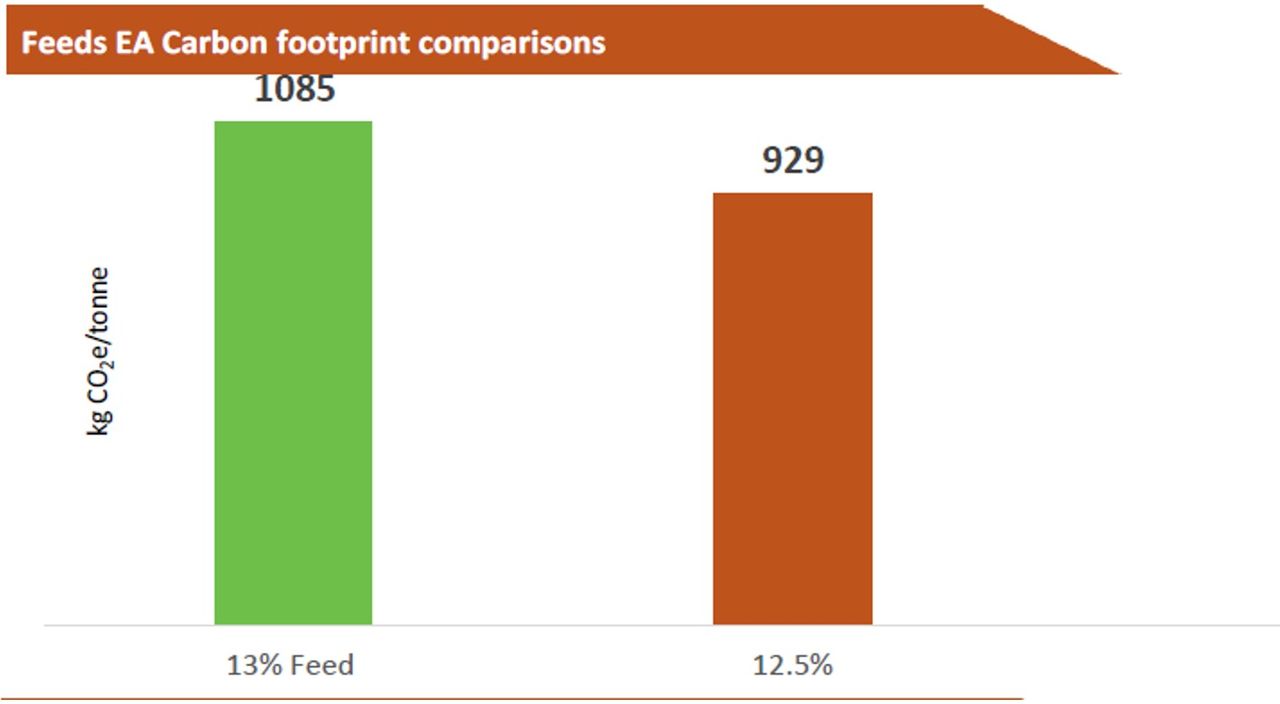
Graph 2 shows a Carbon footprint assessment of a 13% feed versus a 12.5% feed, where a reduction of 156 kg (17%) CO2e/t can be seen.
This was a result of reducing the soybean meal of the diet by 5% (7.5% down to 2.5%) and adding Optigen at 0.5%.
Both rations have the same energy value and the 12.5% feed with Optigen has a higher soluble crude protein with a better balance of ruminally degradable nitrogen (PDIN) and metabolisable protein supply (PDIE), meaning less nitrogen waste, therefore less energy wasted by the cow.
Matching grass quality to the cow’s demands
Considering that an Irish cow’s diet is made up of 90% grass, the question is often asked ‘how much influence can we really have over the efficiency of the rumen?’
Converting kg of grazed grass into kg of milk solids needs to be at the forefront of every farmer’s mind when it comes to feed efficiency. Focusing on grass quality throughout the entire grazing season can benefit the rumen and ensure it is working as efficiently as possible.
Testing grass for dry matter, energy, protein and fibre throughout the year can have a large impact on the performance of the cow. A cow consuming 17kg dry matter of grass with an energy value of 12 ME is capable of producing 24L from grass alone, giving a feed efficiency of 1.4. For every kg of grass consumed, the cow should be producing 1.4L of milk.
In short, the answer is no, as a cow will struggle to consume more than 17kg dry matter of grass within 24 hours. This is where the importance of grassland management and testing grass comes into play.
To sustain this cow’s maintenance and milk production, they will need to be fed a supplementary feed. If the grass is tested, then it is easy to select a suitable feed to complement the grass.
In this situation, 2kg of a high-starch feed with a feed value of 11.5 ME will provide the cow with enough energy to preserve production and maintenance. With a total dry matter intake of 18.7kg, this gives the cow a feed efficiency of 1.5.
Improving the cow’s feed efficiency will lead to a decrease in the farm’s carbon footprint. This shows that, as a country, we do not necessarily need to carry any extra cows, putting farm stocking rates under pressure.
However, we need to focus on breeding more efficient cows that can convert kg of grass into kg of milk solids. With even just an increase in feed efficiency going from 1.4 to 1.5 for a cow consuming 5t of dry matter in a year, this is an increase of 38kg of milk solids per cow based off an average milk protein of 3.4% and milk fat of 4% in one lactation.
Not only is this reducing the kg/C02e per kg/MS FPCM (fat- and protein-corrected milk), it also benefits the farmer, as they are producing extra kg of milk solids from the same amount of feed.
Forage quality
A crucial area to focus on is forage quality. Improving the quality of the silage being fed to cows and youngstock, in particular, can help reduce the carbon footprint of the farm. T
he first step to improving silage quality is to test the silage you’ve have already made. This can show you what feed value is in the silage for the winter. Silage needs to be tested for dry matter, energy, protein and fibre.
Youngstock require protein in order to grow and hit target weights for breeding and turn out. Protein in grass silages is between 12–15%. The higher the protein content of the silage, the less imported protein needs to be fed in rations, reducing the air miles of these ingredients and, subsequently, reducing the carbon footprint of the farm.
Lowering a farm’s footprint goes hand-in-hand with increasing farm efficiency and, therefore, profitability. Through working together, improving farm management practices and embracing new technologies, you can move a step closer to your sustainability targets.
Contact Alltech to find out more: alltech.com/Ireland.
Managing the protein challenge
Learn more about Alltech’s sustainable solutions to the protein challenge, including managing the impact of over-feeding crude protein and reducing the environmental impact with an alternative protein source while improving feed efficiency.
Hear from industry experts on implementable techniques and strategies on Thursday, December 10, at 2:00pm. To register, just [button link="https://go.alltech.com/managing-the-protein-challenge"]click here[/button]
Sponsored by